The Party's prescription for addressing public discontent is deeply flawed - but it isn't changing
Aug 20, 2025
Authors’ note: This piece was written in November 2024 when we noticed the regime applying new priority and urgency to stamping out public discontent. This signaled to us it had become a persistent problem, not just contained to the Covid phase, and one that threatened regime stability.
Since then, many of the follow-on effects we said to watch for have materialized.
The Central Social Work Department has become involved in economic policy meetings
Foreign journalists report dramatic increase in sensitive topics deemed off-limits
The Party has carried out discipline inspections on more senior members (most recently Liu Jianchao, who had come up through the discipline apparatus himself)
Both foreigners and Chinese are experiencing tighter travel restrictions
Bottom line: dictatorships look strong on the outside but are actually quite brittle. (Democracies, on the other hand, look chaotic but are actually quite resilient.)
Pessimism and frustration in China has persisted even after the end of Covid. For the first time in decades, Chinese people are not confident they will be better off than their parents were. This is a growing, strategic-level concern for the Party. As a result, the public security apparatus is in overdrive. The regime is expending lots of meeting time, ink, and treasure looking inward. Xi’s prescription for addressing it remains stubbornly ham-fisted: more repression, as usual. This crackdown makes economic and societal flourishing ahead less likely.
But in assessing whether this makes Xi more or less likely to take risks beyond his borders (like Taiwan), what matters is how confident Xi is feeling, regardless of the reality on the ground. So far Xi has reacted with defiance - not temperance - to naysayers.
Internal dissent in China has become noticeably more intense in the last couple of years. Xi Jinping is concerned and responsive, but not in a way that will alleviate dissent. Instead, he is doubling down on repression, surveillance, and Party overlordship into every aspect of life in China.
While stocks were surging in early November on stimulus speculation, Xi and his top deputies were unleashing a barrage of warnings to senior Party leaders across the country to better control the dissent bubbling up. Within a span of ten days, Xi gave two speeches on the topic to top Party leaders from across the country. A “social work” conference was convened for the first time. Xi’s top security official convened a special meeting to address the concerns. Official media pumped out front page articles and headline news on the urgency of the work.
As is the pattern, Xi’s increasing paranoia is combined with an intensification of defiance against naysayers or obstructions to his pursuits. The Chinese people and anyone operating inside China will feel the pain of this campaign most acutely.
Implications for readers
Xi’s need for greater ideological unity will accelerate his campaigns of “rectification” against those people and trends misaligned to the Party’s strategic direction – more crackdowns, more investigations, more punishments. Fear of being targeted will likely intensify across China, reducing economic productivity as useful pursuits are replaced with study sessions and demonstrations of loyalty. Expect increased capital controls and restrictions on physical travel into, out of, and around China, especially for Chinese citizens. Assume a higher scrutiny on words and actions, applied to companies and executives that do business in or with China.
Expect an intensification of regulatory and legal crackdown, as well as increasing frequency of investigations and detentions. Foreigners will not be spared, save the firms for which the Party judges there is an active need. The Patriotic Education Law may be invoked as a cudgel.
More suspicion of NGOs, religion, Westerners, and Western businesses operating in China. Reduced opportunity for open dialogue as Chinese counterparties turn inward to protect themselves from scrutiny of the relationship.
Increased capital controls, data restrictions, and restrictions on travel as Xi’s fear of disloyalty increases.
More Party efforts to unify ethnicities. Increased scrutiny of any Western attention on the Xinjiang genocide, even including lawful discrimination against products from Xinjiang (see PVH investigation for complying with UFLPA).
Potential for a new, darker “mass line campaign” to force sufficient patriotism and enthusiasm out of the Chinese people. This would create a large drain on the country’s resources as fear permeates normal life and replaces the human productivity and flourishing that Xi actually needs.
Cadres at all stations across the state and business world will likely become more focused on demonstrating political loyalty. This inhibits their normal management functioning and creates further inefficiencies in the system.
The trend
Xi Jinping delivered a unique reprimand of public “doubts and misgivings” regarding the Party’s direction.
We detect high-level concern – but also indignation – about the perception of mass discontent, especially as the pain caused by Xi’s aggressive restructuring agenda intensifies.
China’s economic ‘failure to thrive’ since the pandemic is no secret, despite the Communist Party’s best efforts to obscure it. The social discontent it has caused is even more difficult to detect, by design. We see signs from Xi Jinping, though, that he is both aware of this discontent and increasingly concerned about it. A headline speech Xi gave to senior Communist Party members at the end of October points to his concern. His prescription is more Party control in more places, more suppression of the free flow of information and opinions, and a greater effort to “promote positive energy” across the population.
China’s economic growth was slowing even before the pandemic. From as early as 2014 Xi had already indicated “security” should be a co-dominant priority with “development”, indicating that economic prosperity would no longer serve as the lodestar for all Party decisions.1 Instead, reorienting the country into a wartime footing had become the primary logic for how cadres should govern. Xi gave a mandate to create a garrison state to face the complex and unprecedented threats of Xi’s era, leading to a comprehensive securitization of the country. Tightened political controls and a grand restructuring of the economy dampened growth.
The Chinese people, meanwhile, had begun suffering under this forceful reshaping. The private sector engine of economic growth was forced to recoil under ham-fisted Party rule. The vibrant financial hub of Hong Kong was brought to its knees and made to conform to absolute Party rule as just another Chinese city. Foreign investors became increasingly uncomfortable with the data-poor and capricious investment landscape, reducing their holdings and sapping the country’s economy of the western capital flows it had relied upon for decades to fuel its growth. Then Covid-19 allowed Xi’s most strident securitization impulses to reign unchecked for years, crushing household and investor confidence that the future would be better than the present. The Party tightly controlled badly needed information, refused to take any responsibility for the outbreak or make any necessary reforms, and enforced draconian lockdowns without regard for human well-being. Capital and human flows out of China accelerated, unemployment skyrocketed and did not allay, and no amount of propaganda could unstick the massive savings being clutched by uneasy Chinese citizens.
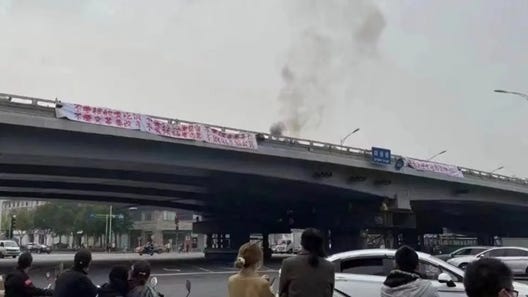
Discontent followed. The “lying flat” movement in 2021 demonstrated the widespread malaise felt by workers and especially young people who lacked agency to change either their station in life or the system that stripped their future of promise.2 Outbursts of violence increased, like the shocking pilot suicide on an Eastern China Airlines flight in March 2022 that nose-dived into a hill in southern China, killing all 132 onboard.3 Early in the morning on October 13th, 2022, just days before Xi was set to start his third term at the 20th Party Congress, the world caught a rare glimpse of just how deeply the frustration ran. A lone protestor, dressed as a construction worker, hung a set of highly subversive banners on an overpass in Beijing, burned tires and shouted through a bullhorn to draw attention. His most provocative message: “Remove dictator and national traitor Xi Jinping”.4
Pictures of the scene spread like wildfire across the internet and sparked similar protests around the world. The man was dubbed “Bridge Man” in overt references to the 1989 Tiananmen pro-democracy protests and the iconic “Tank Man” who defied the Party’s army tanks. By early November Apple had restricted Chinese users’ ability to share content publicly over Airdrop – a common protestor tool in authoritarian regimes where an internet connection risks exposure. In the extreme censorship environment on China’s internet, the phrase “I saw it” was used to express a knowing sense of solidarity.
Burning tires and brazen banners: Sitong Bridge in Beijing where a lone protester, dubbed “Bridge Man” after the iconic 1989 “Tank Man”, brought attention to his subversive calls for Xi’s removal.
By the last days of October 2022, there were already indications the Party had decided to lift its draconian zero-covid policy. We judge this timing to be the result of Bridge Man. While the rollback was not made official until a December State Council decision document, provincial officials were already describing the virus in less deadly terms by the first days of November and criticizing overzealous lockdowns, in a reversal from their previous guidance. Thus, the White Paper protests that followed in late November – probably the largest in decades – were a continuation of the emboldened public response to Bridge Man, rather than an isolated event and the trigger for the lifting of Zero-Covid. Still, the extent of the protests may have influenced Xi to keep all restrictions lifted even as over a million people died in just one month, and an estimated 1.5-2 million people died in eight weeks.5 After all, the protests were sparked by anger over unreasonable Zero-covid restrictions which prevented 10 residents of an Urumqi apartment building from escaping a fire in time to survive. Zero-covid relief was clearly the appropriate pressure-relief valve in that case. Today, it is not so straightforward for Xi.
By 2023, reports of open contempt for Xi on the streets leaked from the mainland. The foundational conditions of unhappiness had not abated, as Xi had lifted Zero-Covid but created an even tighter environment of suppression and fear in response to the people’s unhappiness with it. In 2023, China surged to become the fourth largest source of migrants crossing the notoriously dangerous Darien Gap in Colombia, enroute to the U.S. southern border.6
In 2024, we have witnessed an unprecedented number of random acts of violence across China in “pressure-cooker” style outbursts of frustration. These include stabbings, car rammings, and even a spectacular murder-suicide of a provincial official in September. November has been a particularly bad month, with at least 43 killed and 70 injured by such attacks.7
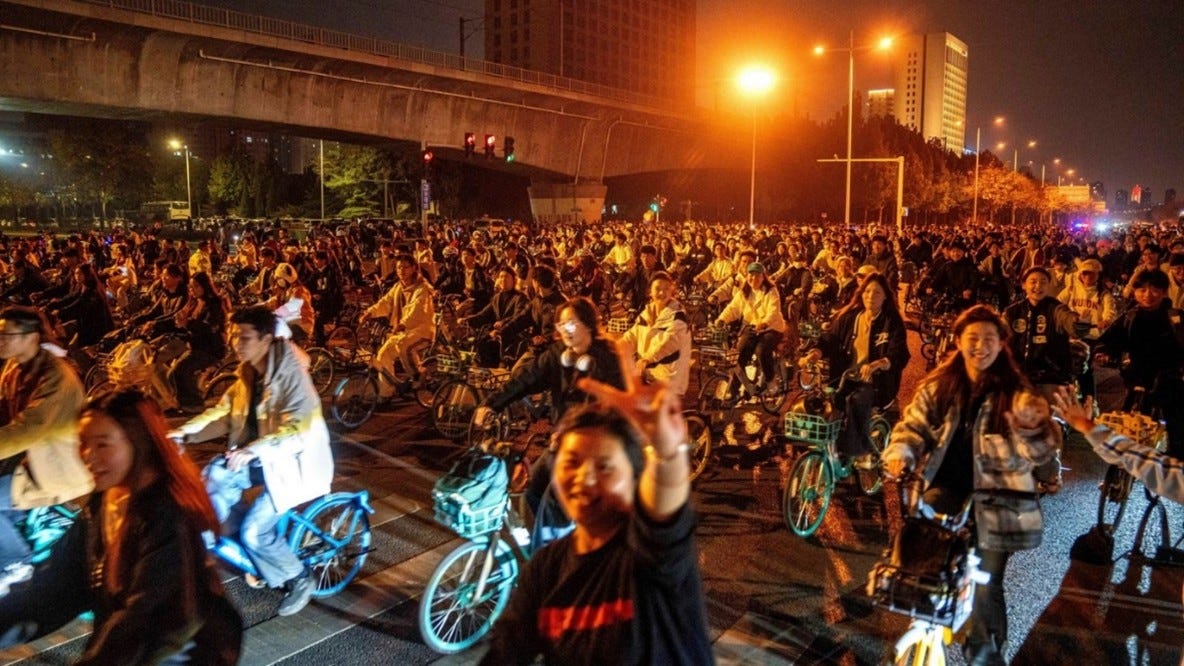
In November 2024 we have also witnessed a striking mass movement of shared emotion through the Kaifeng nighttime bike rides. A small group of students first made the 40-mile bike ride from Zhengzhou to Kaifeng in June to try the city’s famous dumplings. The idea took off, offering a much-needed (low-cost) shared and emotional experience, especially for students and young adults struggling through almost 50% unemployment. By the night of November 8th, an estimated 200,000 people were on the road making the ride. That was its peak, as the authorities had grown uncomfortable with such uncontrolled mass and shut it down the next day.8
A growing movement of youth nighttime bike rides from Zhengzhou to Kaifeng, up to an estimated 200,000 people in a single night, spooked authorities enough to shut down the rides completely. When protests aren’t allowed, any gathering of people wanting something for themselves becomes a revolution in the eyes of the Party.
The Party has not been standing still in the face of these public displays of unhappiness. Their response has been a classic crackdown campaign, not loosening. The Ministry of State Security chief Chen Yixin, appointed at the 20th Party Congress just days after Bridge Man took his stand, has intensified an aggressive hunt for subversive forces at home and abroad. (this is merely a sampling – there has been too much activity to list).
In June 2022 a national security hotline was set up by the Ministry of State Security, offering up to CNY 100,000 for information on spies or any activity “undermining national security”.9
In the spring of 2023, Chinese authorities raided the offices of business intelligence firms and detained many of their employees, calling them “accomplices in overseas espionage”.
In March 2023 the Party created the Central Social Work Department (中央社会工作部) to better monitor and control the masses.10 The work of this body used to be carried out by the Ministry of Civil Affairs, but it has been taken out of the state and brought into the highest levels of the Party itself. The Chinese name echoes that of the entity created in 1936 which would eventually become the Ministry of State Security, the nation’s largest and most powerful intelligence body. It was called the Central Social Affairs Department (中共中央社会部) and was the Party’s intelligence and counter-intelligence organ, used to find and kill Mao’s political enemies.11 Up to 10,000 people are estimated to have been killed during the Yan’an Rectification Campaign, a period Xi glorified by taking his new Politburo to pay homage to Yan’an immediately following their inauguration at the 20th Party Congress.
In April 2023 the National People’s Congress passed into law a beefed-up version of the Counterespionage Law. That month Chen Yixin wrote that officials must combat hostile forces at home and abroad that seek to subvert China’s political system and suppress the nation’s rise.
In October 2023 the National People’s Congress passed into law the Patriotic Education Law, tightening ideological controls both online and beyond China’s borders. In the words of the China Media Project, it “legislates love and devotion to the Party.”12
In April 2024, the Ministry of State Security chief Chen Yixin published a pair of essays in the Party-run Study Times announcing a new campaign to intensively carry out “the five antis”: struggles against subversion, hegemony, secession, terrorism, and espionage. Within anti-subversion, the first anti, he called for being “highly vigilant against Westernization and division schemes by anti-China hostile forces”. Chen hailed the national security work of the Party over the past decade, highlighting that the law is “a powerful weapon for maintaining national security”.13
In October 2024 PRC internet regulators banned the use of homophones, or sound-alike words, which are commonly used online to refer to sensitive words and topics the Party has banned.14
During Halloween 2024, Shanghai restricted the wearing of costumes in public, fearing they would be used to make political statements (as they had been in 2023, especially to criticize China’s surveillance and covid restrictions).15
We look to Xi Jinping’s level of personal attention on this issue as one metric to gauge how much it might be impacting his decision-making. In 2024, but especially in the last month, Xi has been spilling more ink and spending more time addressing Party ‘disunity’ and public dissent. Here are five illustrations of Xi’s increasing concern:
In May 2024, during a national conference on public security work, Xi called for the police force to promote the modernization of the country's public security efforts.
In June 2024 state media published an explanation of Xi’s use of several boat-related metaphors, around the time of the Dragon Boat Festival.16 The main idiom discussed was 水可载舟,亦可覆舟 “Water can keep a boat afloat but can also sink it.” The meaning is: With the people’s support (read: compliance), the CCP stays in power; with mass discontent, the Party is existentially threatened. See below.
Water can keep a boat afloat but can also sink it
Image: CCTV
An ancient Chinese proverb pointing to the delicate relationship between the regime (the boat) and its people (the water). With the people’s support (read: compliance), the CCP stays in power. With mass discontent, the Party is existentially threatened.
CCTV published this as a seminal metaphor of Xi’s, but it doesn’t appear he uses it frequently at all. Instead, this is messaging to cadres that the water is at risk of tipping the boat.
Xi used this metaphor when he was Party Secretary of Zhejiang to describe how the environment enables economic development but can impede it if the environment is allowed to degrade through pollution.
Chinese official media began using the metaphor around Xi’s mass line campaign in 2013, whereby he incited party members to enforce the people’s loyalty through an anti-corruption campaign.
Xi himself first used this boat metaphor in a published speech in October 2016 at the 80th anniversary of the Long March. He called on cadres to strive on their “new Long March” to unify all peoples across the country behind the Party’s efforts, in order to “resolutely safeguard national unity and resolutely oppose any separatist activities”.
On September 30th, the Party’s political theory journal Qiushi published a collection of 29 excerpts from Xi Jinping’s speeches on the special topic of patriotism. The title: “Vigorously carry forward the great spirit of patriotism, and constantly push forward the great cause of building a strong country and national rejuvenation”.17
On October 29th, Xi himself gave a speech to the Central Party School urging senior Party members across China to “strengthen their confidence” in the latest round of reform measures and “better unite to advance reform”.18 His reference to “doubts” and “misgivings” as well as “people’s intense gains and losses” hints at Xi’s awareness that there is great social pain being felt lately across China, and the Party needs to either drown it out or co-opt it before it causes them trouble. Whereas in previous speeches at the Central Party School Xi emphasized the need for creative ideas from cadres as to how to best tackle the challenges ahead, in this speech he is single-minded in his rebuke: you’re either with me, or you’re against me. Full passage from his speech below:
Xi Jinping pointed out that it’s of the utmost importance to build broad consensus and fully bring every positive factor to bear to smoothly move the reforms forward. You must earnestly do good work in guiding public opinion,strengthen positive propaganda, sing out the main melody, and transmit positive energy. Strengthen the research and interpretation of the major theoretical viewpoints that the Plenum’s “Decision” put forth. Especially strengthen the propaganda and interpretations geared towards the grass roots and the masses, promptly allay doubts and dispel misgivings, respond to society’s deep concerns, build broad consensus, construct across the whole Party and whole society a foundation of reform built on ideology and the masses. Lead the cadres and the masses to increase their consciousness of the big picture, correctly handle the adjustment in stakeholder relationships and people’s intense gains and losses that occur during reform.19
Xi spoke again on the issue at the inaugural Central Social Work Conference held in Beijing Nov 5-6.20 The Central Social Work Department had met earlier in the year (February) for the first conference after its creation in 2023, but Xi had not attended. This time, the conference was convened for Xi to be able to emphasize the message personally. The conference was particularly focused on the emergence of “a large number of new economic organizations and new social organizations” that have emerged as the economy has undergone restructuring, especially the “new employment group” of gig workers (counting 84 million people). Such a group as gig workers poses a particular threat of mass discontent and organized protest, given their bleak economic prospects and lack of corporate oversight. The Party needs to “conduct social work” to ensure these newly disadvantaged groups do not become malcontent. They need to be reached by Party cadres so they can “feel warmth and positive energy” (read: not protest their conditions).
Looking ahead
The direction is clear – Xi will choose repression, not structural change, to deal with dissent.
Tactical delays in the economic restructuring process which has caused so much pain are possible, but not reversal.
Xi’s message to the Party and the people is that ‘the beatings will continue until morale improves’.
These ‘beatings’ may very well include regime violence against future public demonstrations, despite the likelihood of western sanctions in response (a la Tiananmen).
Xi believes deeply in the correctness of his programs, despite the economic pain and international backlash they are generating. For one, he needs to finish his work creating a garrison state able to survive war – cold or hot – with the United States. Secondly, the continued gathering of wealth, resources, and power into the Party’s hands is foundational to its ability to use a smaller and smaller number of trusted cadres to control the immense population. Third, Xi’s personal and professional history have convinced him that struggle and hardship are the formula for power and success, both individually and for China. This is why he frequently asks his cadres and his people to learn to ‘eat bitter’ and harden themselves for the struggles ahead.
Political rectification, meanwhile, is the Party’s time-tested formula for eliminating dissent from those who refuse to align and scaring the rest into compliance, no matter what they believe. The home of the original rectification campaign carried out by Mao, Yan’an in northwest China, is as close to a spiritual center for the Party as it can have. Xi is recreating the terrifying Yan’an experience of backstabbing and ideological warfare in modern-day Beijing. Today Xi has a modern techno-surveillance state to assist. He calls the Party’s critical control over officials, the gun, and the pen his ‘tools of dictatorship’, which enable the Party’s ultimate power. And critically, it is the Party’s willingness to continue to ‘rectify’ ideological disunity which Xi believes is the key to longevity. As Xi famously said, the Soviet Union fell because no one was “man enough” to stand up to the minority leaders (namely Gorbachev) taking it down a wrong path. Similarly, the great lesson learned from 1989 was that the Party had become too tolerant of political laxity at the top and dissent in the masses. Never again, they vowed.
Expect Xi’s paranoia and frenzied crackdowns to only intensify as he describes his operating environment as becoming severe, requiring even more loyalty and unity. If the Soviet Union is a guide – Xi does look to Stalin as a model – rectifications will intensify as conflict approaches, too. Stalin accelerated his purges of top generals as World War II approached, as his paranoia of treason increased. An editorial published on November 1st in Qiushi magazine made a renewed call for “turning the blade inward” in accordance with the Party’s original inheritance, describing the continual witch hunt work that is a hallmark of Marxist-Leninist political activity. “We must be reverent, remain wary, and defend the bottom line” (read: the Party’s authority), it said.21 Investigations and punishments will continue to be doled out to the highest levels of the Party by the Central Committee for Discipline Inspection. Xi may test his key officials and advisors with a smaller-scale task to judge their readiness to follow his direction no matter the outcome.
“Party members and cadres must constantly cultivate the courage to turn the blade inward, diligently dust off “ideological dust” [maintain purity of thought], frequently break the “thieves in the heart” [which cause doubts], constantly improve the state of their politics, ideology, and morals, and ensure there are no delusional thoughts or rash actions.”
-November 1, 2024 Qiushi editorial calling for renewed self-revolution inside the Party to eradicate the “viruses” within
Not only does Xi believe in the correctness of plowing forward, but he has also hinted at its existential necessity. At this point, there is no turning back. CCTV highlighted another important boat metaphor Xi uses in its feature piece this summer: 逆水行舟、不进则退. “Like rowing a boat upstream, if you stop moving forward, you’ll fall back.” His description of China as pushing against the tide points to his defiance in the face of resistance. Xi most recently used this metaphor on November 15th when speaking at the APEC CEO Summit in Peru.
He was describing how the PRC must face the threat of Western decoupling by forging ahead with continued efforts at globalization. At home, Xi has given himself limited policy space to address the people’s discontent without reversing his strategic direction of restructuring the economy and “struggling” against the West. His 2024 mantra of “establish first, and then break” (先立后破) does allow for some tactical delays in restructuring to allow the country to catch its breath periodically.
The identification of existential threats, “encircling and suppressing” China from abroad and subverting social order from within, provides the Party a new raison d’etre as the only form of leadership able to steer China through. As breakneck growth naturally slows on China’s way to becoming a fully developed economy, the Party’s promise to the people – and the reason they should continue to put their faith in the Party and only the Party – has to shift from improving livelihood to something more lasting. The Party, in turn, can make the perception of threats as lasting as it needs. Thus follows a mind-bending logic chain: Xi can’t let up on the repression because the Party’s new raison d’etre is to prevent social instability. But the social instability is because of Xi’s repression. He’s locked in a forward momentum. Thus, there is also a sense of desperation in the phraseology of sailing upstream, that they either make it through or drown catastrophically.
The signals to watch
We are considering what Xi could use as an internal relief valve to mitigate dissent without deviating strategically.
We are watching proxy measurements of mass discontent, Xi’s personal attention to it and language used to describe it, and the mechanisms of control the Party will tighten to cow the people into greater submission.
Signals of dissent
Human and capital flight out of China.
Low measures of consumer confidence may correlate to discontent
The U.S.-based non-profit Freedom House maintains a China Dissent Monitor, as one data source
Censorship targets and intensity: keywords, sites, and people targeted
Signals of Xi’s concern about it
Xi’s language around the urgency of correcting insufficient conditions of loyalty and ideological unity.
Frequency and seniority of Party discipline investigations.
Initiation of a new “mass line” campaign.
Watch Chen Wenqing, the top security official, and Wu Hansheng, the head of the Central Social Work Department, for the execution of Xi’s guidance on stamping out dissent.
Watch for:
Constraints on public funding and resources, as Xi is forced to direct ever more to internal security.
Further controls on information, data, and even travel.
Use of Patriotic Education Law to force enthusiasm and suppress discontent.
Be alert for another internal ‘relief valve’ Xi might use to alleviate discontent, similar to the lifting of Zero-Covid. It is still unclear what this could be.
In 2024 we have noticed a lot of high-level Party discourse and political interest in the “western” and “border” regions. Might there be renewed and amplified activity around anti-terrorism, westward migration, arming the border, and/or other?
Taiwan “separatists” have been given increasingly distinct rhetorical treatment in recent years, treated separately from the rest of the people on Taiwan who would supposedly happily submit to CCP rule. The Party could attempt to direct the Chinese people’s unhappiness towards this somewhat fabricated group, although it’s unclear how that could be done constructively to social and economic morale.
We believe the Party will most likely only consider internal relief valves, where it can control the dynamics and the medicine does not bring about more harm than it cures (like initiating a war would). Historically, regimes do not conduct wars of aggression to ‘distract the people’ from internal troubles. See Geoffrey Blainey, Evan Luard, and Michael Howard’s work on causes of war for more. ♦
Thanks for reading Red Regime! Subscribe to receive new posts.
Further reading:
The Chinese National Security State Emerges from the Shadows to Center Stage, Tai Ming Cheung, China Leadership Monitor (Sep 2020).